
To All My Students Feeling Nervous About Hōʻike…

Every year around Hōʻike season, I start hearing the same thing.
“Dr. Trey, I’m nervous.”
Some students whisper it before class. Some tell me after rehearsal. Sometimes it’s the parents who mention it first.
The funny thing is that after decades of performing, teaching, recording, and standing in front of audiences, I still get nervous too. That may surprise some of you. By now, you’d think the butterflies would be gone. They’re not. The question isn’t whether you’ll get nervous. The question is what you’ll do about it.
Nerves Are Normal
Nobody likes making mistakes in front of other people. Whether you’re playing your first song or your hundredth performance, stepping onto a stage can make your heart beat a little faster. That’s normal. In fact, if Hōʻike is important to you, it would be strange if you didn’t feel at least a little nervous. The goal isn’t necessarily to eliminate every butterfly. The goal is to keep those butterflies from taking control.
The Best Cure I Know Is Practice
Over the years, I’ve heard all kinds of advice about nervousness. Take deep breaths. Visualize success. Think positive thoughts. Get a good night’s sleep. Those things can help.But after decades of performing and teaching, I’ve found that one thing reduces nervousness more than anything else:
Practice.
Not wishing. Not hoping. Not talent. Practice.
Why Practice Works
Nervousness often comes from uncertainty. Will I remember the chords? Will I miss that transition? Will I forget what comes next? Will I get lost?
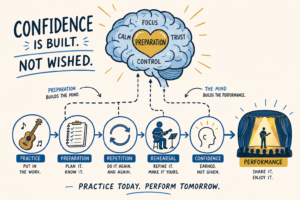
Every time you practice, you remove a little bit of that uncertainty. When you’ve played a song once, it feels unfamiliar. When you’ve played it ten times, it starts to feel comfortable.
When you’ve played it a hundred times, your hands begin to know where to go without you having to think about every movement. That’s where confidence comes from. Confidence isn’t something you magically feel before a performance.
Confidence is something practice creates.
Every rehearsal is a deposit into your confidence account.
What To Do When Nerves Still Show Up
Even with preparation, nerves sometimes show up anyway. That’s okay. When that happens, take a moment to slow down. Take a few deep breaths. Let your shoulders relax. Focus on the first measure instead of the entire song. You don’t have to perform the whole piece right now. You only have to play the first note. Then the next one. Then the next one. Before you know it, you’re in the music.
Want To Learn More?
If you’d like to dive deeper into the topic of performance anxiety, I recommend watching this TEDx talk by pianist and educator Miho Ohki:
As a musician herself, Miho discusses why performers experience stage fright and shares practical strategies for managing it. While I still believe that preparation is the most effective way to reduce nervousness, her insights on breathing, focus, and mental preparation are worth exploring.
A Note From ʻUkulele Legend Kris Fuchigami

I recently asked professional musician Kris Fuchigami about performance nerves.
Here’s what he told me:
“I first stepped on a stage in 2004. Fast forward 22 years and I still do get nervous here and there, especially if the venue that I am playing in is pitch silent. I think that’s because nerves never really go away. You just learn how to control them.
For me, when I start to get nervous and my mind starts thinking a million miles per hour, I tell myself to stop. Take a few deep breaths. Get myself to slow down my heart rate by controlling my breathing. By the end of it, I am more calm and able to think more clearly, and when they call me to the stage, I am ready to go.”
I think Kris makes an important point.
Even experienced performers get nervous.
The difference is that they’ve learned to trust their preparation.
My Hōʻike Advice
Between now and Hōʻike, don’t spend your time worrying about whether you’ll be nervous.
Spend your time practicing. Play your songs again. Then play them again. Then play them one more time. Every repetition makes you more prepared. Every repetition makes you more confident. Every repetition makes nervousness a little smaller. When Hōʻike arrives, take a deep breath, trust your preparation, and enjoy the experience. You’ve worked hard for this moment.
I’ll see you on stage.