

The ʻUkulele Player’s Quandry

TL;DR
ʻUkulele chords often leave out notes — especially the root — to make room for more important color tones. The harmonic function stays intact even when the chord is incomplete, which is why a voicing like the “Hawaiian” D7 (2020) works even without a D. Understanding which notes to omit gives you the freedom to shape the sound instead of relying on fixed chord charts.
The Quandry
ʻUkulele players face a unique musical quandary. We love our four-stringed instrument, but once we move past basic triads and even 7th chords, we suddenly enter unfamiliar territory. Jazz harmony introduces chords with five, six, or even seven different notes — yet we only have four strings available. Something has to give.
The First Note to Go: The Root
Fortunately, experienced arrangers have developed some simple and reliable guidelines for deciding which notes to keep and which to omit. When a chord contains five notes, the root is typically the first note to go. This is partly because the root is often doubled by the bass player, making it unnecessary for the ʻukulele to include it. Even when the ʻukulele is playing alone, dropping the root is so commonplace that it has become part of the instrument’s natural sound. In many ways, this rootless approach contributes to the ʻukulele’s charm — the harmony feels lighter, more colorful, and less bottom-heavy.
Why the Fifth Is Nearly Expendable
When a chord contains six notes, such as an 11th chord, both the root and the fifth are usually removed. The fifth is nearly expendable because it doesn’t contribute as much to determining the harmonic identity. In most chords, the fifth simply reinforces the root without changing the chord’s quality. Whether the chord is major, minor, dominant, or extended, the identity of the harmony is determined primarily by the 3rd and the 7th. These two notes tell us whether the chord is major or minor, stable or tense, and what function it serves. The fifth, by comparison, is neutral — it rarely changes anything.
For example, the fifth in a D minor chord does not change in a D major chord. They both have the note A as the fifth.
Another reason the fifth is more commonly removed from extended chords is redundancy. The overtone series naturally emphasizes the fifth, meaning our ears already “hear” it even when it isn’t played. On a small instrument like the ʻukulele, removing redundant notes helps us prioritize the tones that actually define the chord. Dropping the fifth frees up valuable space for extensions like the 9th, 11th, or 13th — the notes that give jazz harmony its color.
Project: Try listening to a C note, then listen for a 5th an octave above (that note would be a G). Do you hear it? One of my favorite musical minds of the 20th century, Leonard Bernstein, famously demonstrated the overtone series in his Harvard lecture series — something I’d strongly encourage you to listen to if you’re interested in serious theory.
When Chords Get Even Bigger
When dealing with seven-note chords — such as 13th chords — we take it a step further. The root and fifth are omitted, and the often dissonant 11th is also removed. This leaves us with the tones that best define the chord’s character: the 3rd, 7th, and the colorful extensions like the 9th and 13th.
Which Notes Do We Remove?
When chords contain more notes than the ʻukulele has strings, we follow a simple order of omission:
| Chord | Total | Remove | Resulting Core |
| 9th Chord | 5 notes | Root | 3rd, 5th, 7th, 9th |
| 11th Chord | 6 notes | Root, 5th | 3rd, 7th, 9th, 11th |
| 13th Chord | 7 notes | Root, 5th, 11th | 3rd, 7th, 9th, 13th |
These are not strict rules — they are starting points. The ʻukulele often encourages experimentation. You might keep the 11th for tension, remove the 9th for clarity, or drop the 3rd for ambiguity. The important thing is understanding what each note contributes so you can make intentional choices.
These simple ideas help transform impossible-looking chords into playable, musical voicings on the ʻukulele. Instead of feeling limited by four strings, we can think of the instrument as a filter — one that distills complex harmony down to its most essential and expressive ingredients.
The Infamous Hawaiian D7
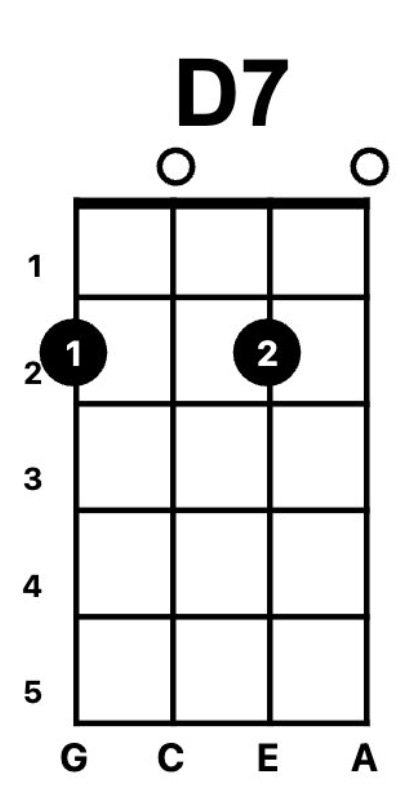
This brings in the opportunity to discuss the often-debated “Hawaiian” D7 chord.
The chord spelled from G string to A string 2-0-2-0 is commonly called a D7 by ʻukulele players. Yet if we spell the notes, we get F#–A-C. That is actually an F# diminished chord. There is no D anywhere in the voicing, and yet ʻukulele players still call it a D7.
Why?
Because as ʻukulele players, having only four strings is the challenge that also gives the instrument its charm. Voicings on our instrument are often incomplete, especially when playing extended harmony such as jazz. Even when the notes don’t fully spell the chord, the harmonic function remains intact, and on the ʻukulele we rely on that function more than strict note completeness.
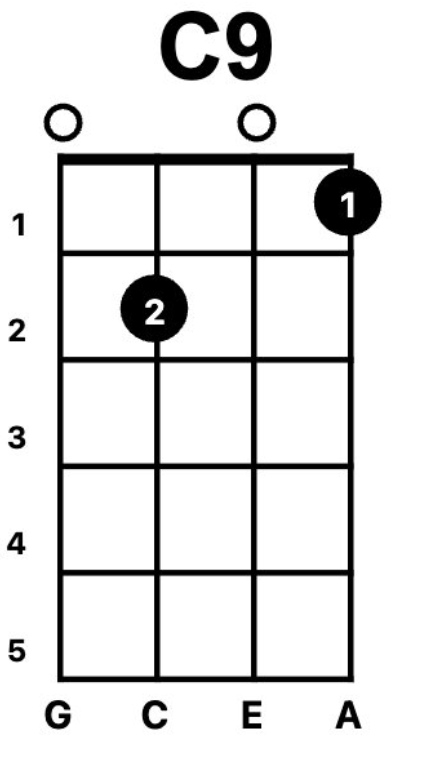
Why call a C9 chord a C9 if it has no C? Because it’s on the ʻukulele. Why call an F11 an F11 if it has no F and C? Because it’s on the ʻukulele. You’ve played chords before that don’t have all the notes in them — now you can be aware of why. As we stated earlier, the first note generally removed from a chord to make room for more notes is the root. With the Hawaiian D7 chord, although it is technically a four-note chord, the D is still implied, just like intentionally omitted notes in extended jazz voicings.
The ear fills in what the fingers leave out. The listener hears the dominant pull to G, and the brain supplies the missing D. The chord behaves like D7, resolves like D7, and therefore we call it D7.
Once you understand this, you stop thinking of ʻukulele chords as fixed boxes and start thinking of them as harmonic suggestions. The notes matter, but the function matters more. On a four-string instrument, this is not a limitation — it is part of the personality of the ʻukulele itself.
Dr. Trey’s ʻUkulele Chord Finder Volume 2

I want to share with you an online chord chart that takes these jazz voicings into consideration. Most chord charts decide for you which notes stay and which ones go. This tool lets you explore that decision yourself. Instead of locking you into one version of a chord, it shows the structure and allows you to experiment with omissions and substitutions. Want the root? Keep it. Want more color? Drop something else. Want the crunchy version? Add tension.
With over a thousand voicings, interactive fretboard identification, and customizable extended chord tones, you are no longer stuck with whatever the chord chart decided for you. You can explore the difference between notes and function — and discover that sometimes the most important note… is the one you don’t play.