
Jus’ Play For Grandma

The Playlist of Your Life… and Why It Matters in the Classroom
If you had to make a playlist of your life, what would be on it?
The songs from your childhood. The ones you listened to with your friends. The ones that made you cry… or filled you with joy. And if, toward the end of your life, your memories began to fade—could that soundtrack bring you back?
That’s the question explored in Power of Music on the Brain, and what it shows is something hard to ignore.
People with advanced dementia—people who can’t recognize family members or hold conversations—suddenly come alive when they hear their music. Not just any music, but songs tied to their life. It’s like music finds a way in when everything else can’t. As the video explains, it acts almost like a “side door into the brain,” reconnecting people with memory, emotion, and identity .
When I Saw It for Myself
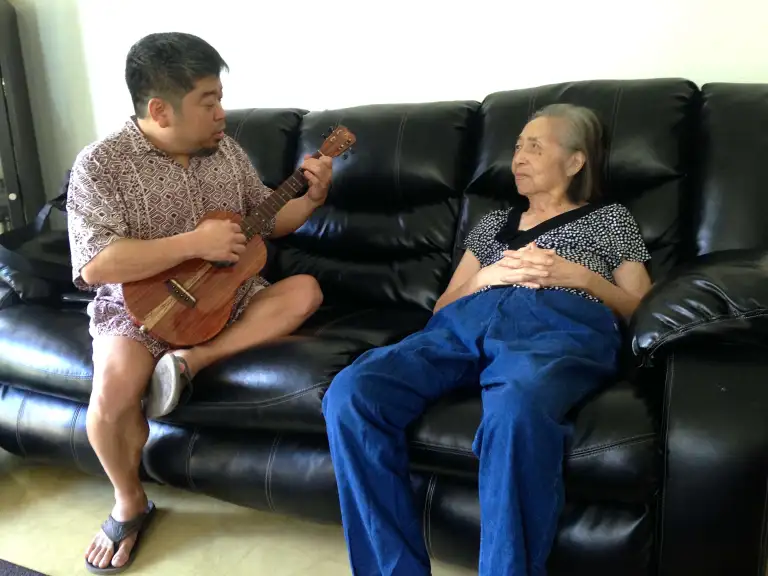
I’ve seen this firsthand.
Several years ago, a friend of mine, Diane Ako, wrote an article about her mother, who was in the final stages of Alzheimer’s. I was invited to come and play music for her.
At first, she was withdrawn and disconnected.
But then I started playing Hawaiian songs.
What I didn’t know at the time was that she had been a hula dancer earlier in her life.
As the music started, her hands began to move.
Not randomly—but with intention. Graceful, familiar movements. Almost like her body remembered something her mind couldn’t fully access anymore. It wasn’t something she had to think about—it just happened.
In that moment, she wasn’t just reacting to music… she was responding from memory. From identity.
And then came the connection. She became more engaged, more present, reaching out and interacting. For those moments, it felt like the disease stepped aside.
What the Science Says
Research doesn’t claim that music “cures” dementia.
But it does show something very specific:
- Music improves mood
- It reduces anxiety and agitation
- It increases emotional expression and communication
In other words, music may not rebuild the brain—but it helps people feel like themselves again.
One reason is that music activates multiple systems at once—emotion, memory, and movement. That’s rare. Most things we experience only hit one or two areas. Music hits all of them.
That’s why it can still work even when other functions are gone.
What This Means for Our Classes
Watching this changed how I think about what we’re doing.
Because yes—we are building our own soundtracks.
Every time you learn a song, you’re attaching it to a moment in your life. A feeling. A struggle. A win. That becomes part of you.
But there’s another side to this that might be even more important.
We’re also learning how to play other people’s soundtracks.
And that matters.
Because one day, someone might ask you:
“Go play something for Grandma.”
And when that happens—just do it.
Don’t overthink it. Don’t worry about whether it’s perfect.
Because you don’t know what that song might unlock.
You might play something that brings back a memory they haven’t accessed in years. You might see a reaction you’ve never seen before. A smile. A movement. A connection.
Maybe even something like what I saw… where the music doesn’t just reach the ears—it reaches the person.
One Thought to Leave You With
If music can reach someone through dementia…
If it can unlock movement, memory, and identity…
Then what is it doing for us right now?
And maybe the better question is:
What other powers does music have that we haven’t even realized yet?
References
Music’s Positive Effects on Dementia – Diane Ako
https://hawaiiirl.com/blogs/musics-positive-effects-on-dementia.html/
Music Therapy and Dementia (Systematic Review)
https://pmc.ncbi.nlm.nih.gov/articles/PMC7709645/
Effects of Music Intervention on Anxiety, Depression, and Agitation in Dementia
https://pmc.ncbi.nlm.nih.gov/articles/PMC10488399/
Power of Music on the Brain | Dementia & Parkinson’s (Video)
https://www.youtube.com/watch?v=rnUSNbqtVJI